The world of SEO, E-E-A-T, knowledge graphs and crawlers has variables with subtle metrics but real consequences. In a previous article I wrote about Metacognition 2.0 — thinking about what artificial intelligences think. Well: those AIs already have a profile on you, defined by the trail of breadcrumbs you left in your digital identity. It is not a future construction. It already exists. It was assembled in silence, with data you voluntarily provided, with behaviors you never thought anyone was measuring.
We are relevant to the algorithm because we are its food source. In classical statistics, an n of 30 is considered a solid sample. Current AIs go much further: each person is an intact sample, free of bias, free of selection effects. You are a dataset of one — and that makes you enormously valuable to systems that need granularity, not averages.
The problem you don't see
Try the exercise: search for an article on Google and watch how YouTube fills with those ads within minutes. Comment on Instagram about a product. Search in Marketplace. That is the visible tip. What happens below is what you don't see: those metrics not only predict your purchase intent — they form mathematical vector sets that model your behavior with enough precision to interest governments, think tanks and multinationals that make decisions with that data.
The formula that moves the graph
There is an equation behind all of this worth understanding, because it explains why digital association is not just reputation — it is mathematics. In a knowledge graph, semantic authority propagates via PageRank:
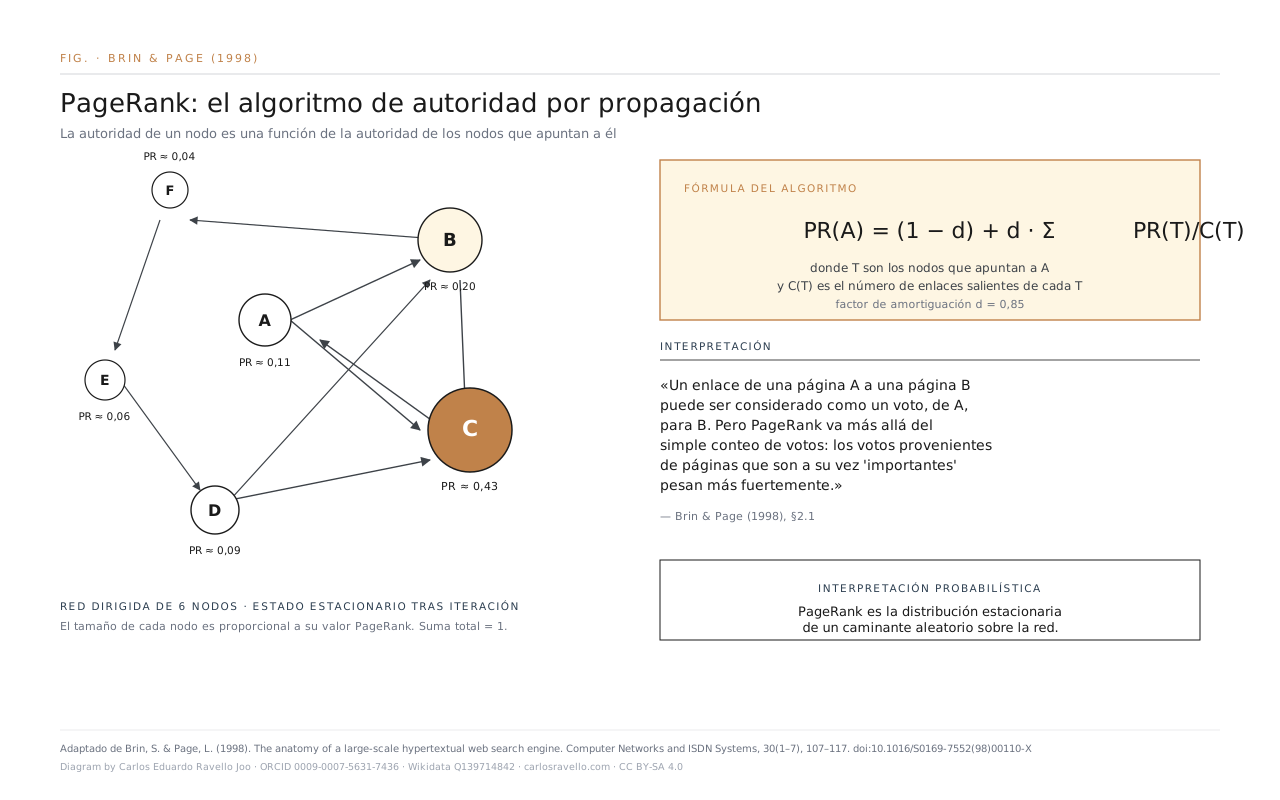
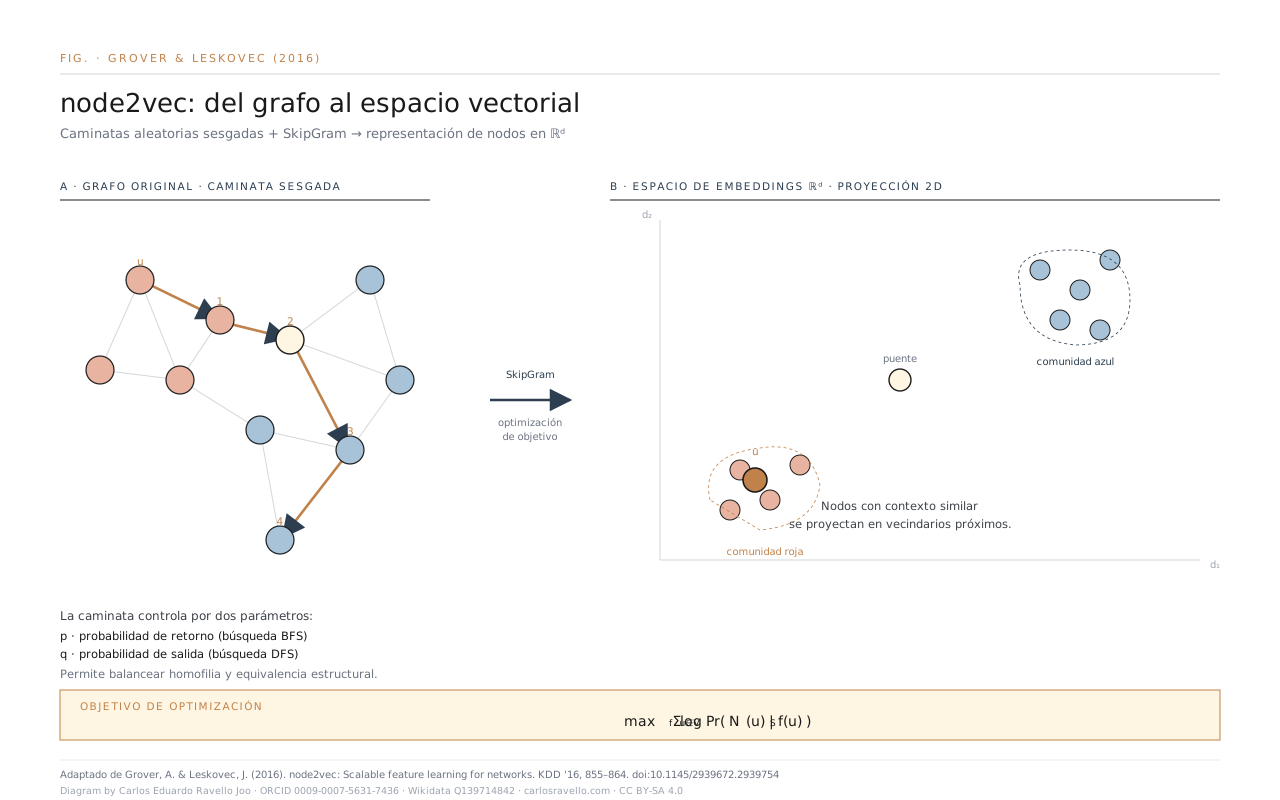
In human terms: if you are connected to a node of low authority or toxic reputation, your own value decreases. Modern systems go further with Node2Vec — they convert each node in the graph into a numerical vector. Your digital identity is not a profile. It is a point in a high-dimensional space. Nodes close to you in that space inherit and transfer attributes automatically. A photo at a party doesn't taint you poetically. It repositions you mathematically in that vector space — and that repositioning has measurable consequences.
It's not new. It just has a new name.
In Mesopotamia the Akkadian king had his intelligence networks before moving an army. The Romans had the speculatores — intelligence agents who traveled ahead of the legions to build profiles of allies and enemies. Sun Tzu wrote about knowing your adversary before paper existed. Even in fiction, Varys, the Spider, already knew: real power is not in armies — it's in knowing what others don't know that you know.
The difference today is scale and speed. What once required years of human espionage, today a crawler does in hours.
What the real world already does with your profile
In the world of CEOs, headhunters and risk committees the rules are not the same. Every photo is measured. Every line on your face is a signal. You think: I have the KOM on the mountain at 5am, epic ride. Your competition, your boss, your auditor already has that data and wonders: does he really have the energy to show up at 8am and hold six hours of negotiation? The algorithms have already weighed you — literally — and know your resting heart rate, heart rate variability, sleep time.
OCR doesn't just read the good — it probably specializes in the bad. A smiling photo of you at a party, a group outing with someone who accumulates silent complaints, an appearance next to controversial people — that is a graph, a node. Semantic authority is inherited. Now it also spreads. Building a structured JSON with correct schema, ORCID, Wikidata and verifiable DOIs takes weeks — I know because I do it. Destroying it by association takes just one deep crawl. Since 2025 Google crawls Meta directly and everything is permanently recorded in the system.
Do you think that insult on Twitter from 10 years ago nobody knows about? Do you think that like on that photo won't be found? They know. There are competitive intelligence services — legal, commercial, with corporate clients — willing to deliver that type of information to whoever pays. The sameAs attribute is exactly who you are in the graph: the sum of all your digital identities collapsed into a single node. AIs resolve it with terrifying speed and effectiveness.
And the conversations you have with AIs also feed the system. Did you tell an AI about the partner who left you? That information enters the training cycles of language models. Google has you clustered by interaction pattern and brand behavior. It is not a single data point — it is the cross-referencing of metadata from all your available information across multiple platforms, correlated in real time.
The iris: the data that has no password
They said the soul is in the eyes. Now it's literal — not as allegory but as data architecture.
Iris recognition already operates in Dubai and Heathrow airports as a biometric identification system. Worldcoin — now rebranded as World, founded by Sam Altman — scanned the irises of millions of people in developing countries in exchange for cryptocurrency. It operated in Peru, Kenya, India, Indonesia. People who handed over their irises for the equivalent of twenty dollars without fully understanding what they were surrendering.
Meta has registered patents for gaze tracking inside the Quest headset — tracking where you look, for how long, with what intensity. What visually interests you is behavioral data as valuable as what you search on Google. Systems like Affectiva and Realeyes read facial micro-expressions in video with precision that exceeds human perception. HireVue — an automated interview platform used by hundreds of Fortune 500 companies — analyzes your expressions during the interview and generates an employability score before a human sees your CV.
And scleral pattern recognition — the pattern of veins in the white of the eye — is more unique than a fingerprint and considerably harder to fake or alter.
A leaked password changes in five minutes. An iris never changes.
Is covering your eyes in public photos paranoia or digital hygiene? I don't have a single answer. I am certain that in five years that question will seem obvious — just as today it seems obvious not to post your bank account number on Instagram.
The documented cases
No need to look far. Cambridge Analytica built psychographic profiles of 87 million Facebook users — it didn't steal them, it inferred them from a personality test app that 270,000 people voluntarily installed. Using the permissions of the time, it accessed the data of all their contacts and built predictive models of electoral behavior with precision sufficient to influence two elections of historical scale. All within the legal framework of that moment.
The FTC documented in 2014 that twelve health and fitness applications shared behavioral data with seventy-six different third parties — including geolocation, heart rate and activity patterns. John Hancock, a life insurance company, adjusts your premiums in real time based on what your Apple Watch or Fitbit records. LinkedIn operates a product called Talent Insights that generates "flight risk" signals — risk that an employee will quit — based on their activity within the platform, and sells it to employers.
And closer, much closer. In the Wilson markets, in the galleries selling PCs and pirated software in any Latin American city, databases are sold with full names, national IDs, addresses, phone numbers, email addresses. At menu price. Built from leaks, scraping of public networks and data you provided at some point without reading the terms and conditions. Your address. Your work hours inferred from your posts. Your children's school visible in the first-day-of-school photos you uploaded in February.
The profile you didn't write already exists. It was built by others, with your data, for purposes you never explicitly approved.
What do we do about this?
Facebook, Instagram, TikTok are not bad in themselves. On Facebook you can still see your aunt's messages — harmless. You can find out about news before anyone else. On Instagram, following the right accounts gives you real advantage. There are beautiful accounts covering photography, industrial art, film color grading, art history that are worth the time. On TikTok we learn mathematics from genuinely good live sessions. The warning is one: don't give yourself away for free.
Behaving like a digital ghost is an option — no presence, no appearance, no participation. Valid. But not for everyone. The other option — being impeccable in everything, never appearing in photos, never making comments — is unsustainable. Nobody actually lives that way.
What does work: publishing deliberate content. It doesn't need to be academic or have a DOI on Zenodo. Something positive, relevant to your field, that doesn't expose your private life and doesn't include comments you know will work against you later. The algorithm builds a profile anyway — the difference is whether you participate in that construction or leave it entirely in others' hands.
It's not a magic cleanse. Not overnight. And note — what is legal cannot be erased. What can be done is build a new reality on top. A deliberate, coherent, verifiable profile that the algorithm reads exactly as you decided. That is Metacognition 2.0. That is the Dynamic Coherence Model applied.