Metacognition is statistically rare. Cognitive psychology research estimates that fewer than 15% of the population practices it consistently — not as an abstract concept but as an operational tool: the ability to observe one's own thinking as it happens and adjust it in real time. It is scarce in humans. In digital systems, it is practically nonexistent as intentional design.
That creates a brutal asymmetry — and it is exactly the asymmetry that explains why BikeLab Studio, a precision bicycle engineering workshop in Trujillo, generates organic traffic from 96 countries; why Zoovet Travel, an international pet export clinic, operates with documented cases from more than 30 countries across northern Peru; and why Katsudomo, a bar in Lima with automatic reconciliation infrastructure, has run from day one without depending on its creator. These are not different industries. They are the same experiment executed three times in different contexts. The method is one: design each system so machines understand it before any human does.
The problem the algorithm cannot solve
Google has a recurring doubt about profiles like this one. Because Google now has its own metacognition — a classification system that, when it encounters a dispersed profile, asks the same question any rational person would: what exactly is this? A veterinary clinic? A workshop? A restaurant? Digital tools? Dispersion triggers an alert. What cannot be classified is not indexed with authority.
The answer was not to simplify. It was to build a dynamic and coherent system that demonstrates to the algorithm that dispersion is not noise — it is the pattern. That the five fronts are not five different businesses: they are five executions of the same verifiable method. That system is called the Dynamic Coherence Model (MCD).
Metacognition 2.0
That is what we call metacognition 2.0 — formally documented in an academic preprint deposited at Zenodo. It is not prompt engineering. It is not technical SEO. It is the ability to mentally model how an artificial intelligence system processes you — and design your presence so that the output is the one you decided, not the one the algorithm inferred by default.
It has been written millions of times that we are in the hyper era — hyper connected, hyper digitalized, hyper automated. True. The world advances and in one year leaves behind by decades anyone who does not pay attention to what changes. On closer inspection, there is a thread that ties the reality of any technology-driven activity: system flow. Everything is — or should be — connected.
Because we are no longer commodities in this era. Whoever fights to be a service loses relevance. Whoever understands the algorithm, whoever speaks to systems in their language, holds a concrete advantage. Abstraction stopped being an aspirational story — it is now an asset for decoding problems beyond the surface problem.
The graph has 400 billion nodes
Google indexes approximately 400 billion web pages. The profile you didn't write — ocular biometrics and algorithmic surveillance How do you enter that vortex without becoming number 401 billion? It is not easy. It is statistically impossible if you play everyone else's game. The odds are against you — and this comes from someone who builds tools that measure exactly those values. Social networks, same story. LinkedIn included: how many professionals repeat the same workplace culture diagrams and the same soft leadership advice from the 1990s that does not actually work? That is being exactly a commodity. Number 401 billion.
Designing reality is not painting the boat more prettily. It is building the sea where you live alone. Everything converges at one point: your presence stops being a footprint and becomes data. Data is verified, noted, converted into truth.
And the data shows that you can have a restaurant, a workshop, a veterinary clinic, a digital business — and the system connects them. A functional, cold system where optimization is the key. Where data verifies what you do, how you do it, why you do it. Few people genuinely see those knots that thread reality — not only digital but life itself — and have the capacity to create systems that bear all the weight of what is now called interdisciplinary practice.
What machines see when they search for you
Metacognition has a history. It is studied, debated — the concept of first-, second-, and third-order thinking. You can think about what you think, about what others think about what you think, about why we all think what we think. It is a valued asset in certain niches.
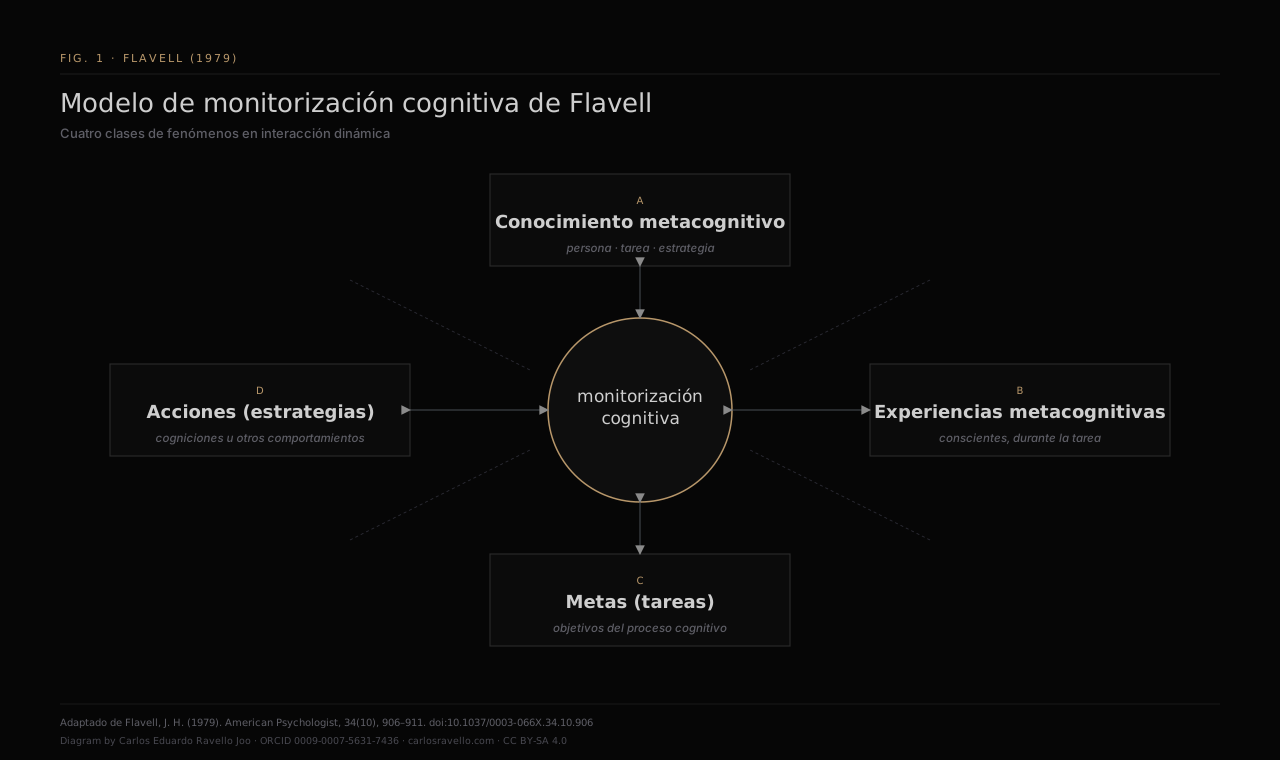
But in the era where we let AIs think for us, something more urgent arises: understanding that the bias of an AI is dangerous not only at the extremes but at the hardest point to notice — the middle. An AI that tells you your work is fine is highly detrimental because it does not know your context, your client, your history. Without that data, the AI takes what it has about you and delivers it packaged from its sandbox. The AI does not judge you. It weighs you. It turns you into a token. You give me this, I give you that.
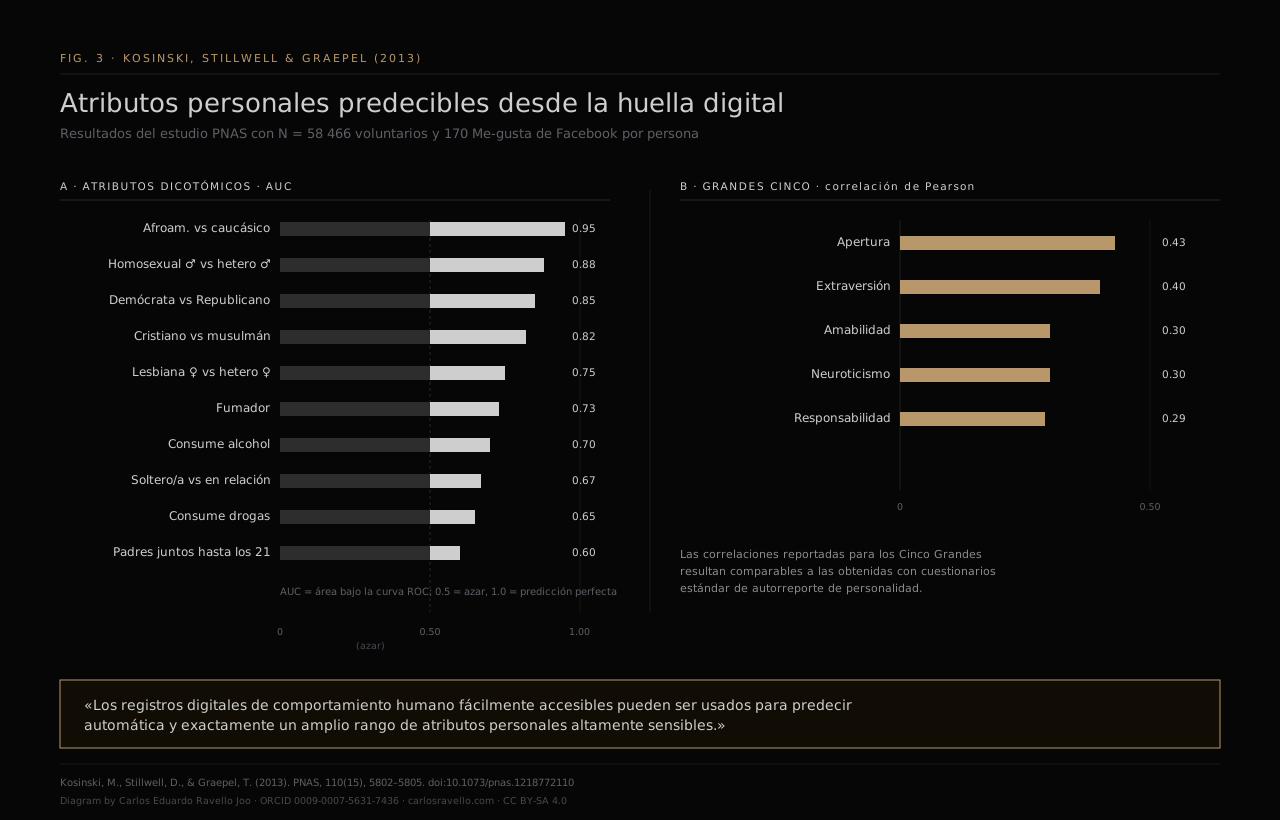
And that is exactly where metacognition 2.0 changes everything. Thinking about what a crawler sees when it reaches your page. What an AI will say about you if you do this or that. Understanding what information to give the system so the system returns what you want — that is precisely what separates the model that updates from the one that does not.
The three systems mentioned at the start are not success stories. They are verifiable data points of the same method applied in three industries where no one expected to find this level of precision. That is the demonstration. Not the promise.
Whoever understands that stops competing for visibility. Starts building gravity.