Metacognition 2.0: Deliberate Digital Identity Design Against Predictive Artificial Intelligence Systems
This paper presents a conceptual framework derived from over a decade of professional practice in the design of digital systems and complex entities. It introduces the concept of Metacognition 2.0, defined as the capacity to deliberately model how predictive artificial intelligence systems process, classify, and assign authority to a digital identity.
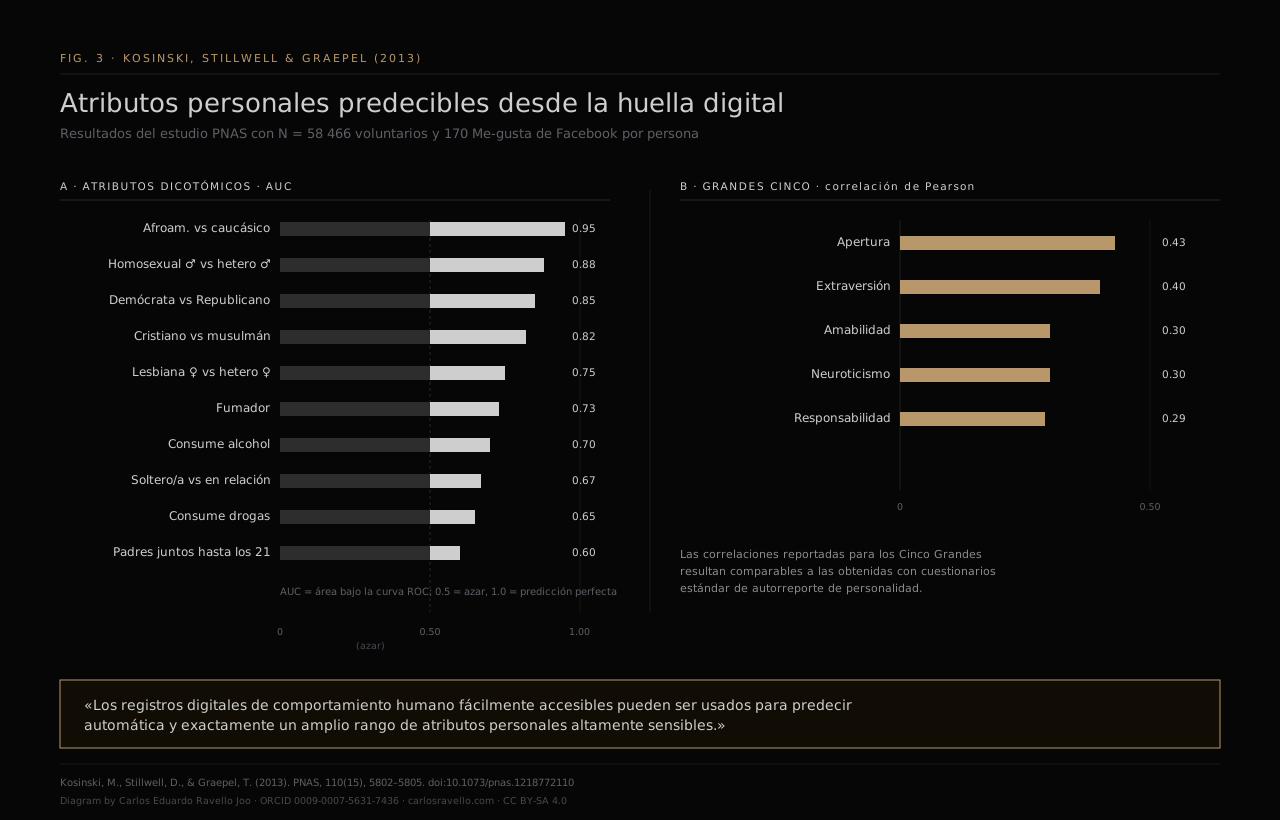
The core premise is that this capacity is no longer optional. Documented evidence shows that digital platforms generate, aggregate, and share individual behavioral signals with third parties, and that digital behavioral records allow inference of personality traits and personal attributes with increasing precision. The agent who does not deliberately manage how they are processed by these systems is not invisible — they are processed by default, with classifications they did not control and frequently do not know about.
The Dynamic Coherence Model (DCM) is proposed as an operational framework to address this asymmetry, formalized through the pseudo-ratio Ω = V/(M+I), where V represents disclosure, M over-protection, and I managed uncertainty. The model was explored through computational simulation with a suggested attractor at Ω ≈ 0.66. Three practical application illustrations across unrelated industries are described as plausibility evidence. Results suggest that disciplinary diversity, correctly structured, generates verifiable algorithmic coherence and reduces asymmetry between the agent and the systems that classify them.
Ravello Joo, C. E. (2026). Metacognición 2.0: Diseño deliberado de identidad digital ante sistemas predictivos de inteligencia artificial. Zenodo, 1–14. https://doi.org/10.5281/zenodo.20092009
@article{ravellojoo2026metacognicion,
  title     = {Metacognición 2.0: Diseño deliberado de identidad digital ante sistemas predictivos de inteligencia artificial},
  author    = {Ravello Joo, Carlos Eduardo},
  year      = {2026},
  publisher = {Zenodo},
  pages     = {1--14},
  doi       = {10.5281/zenodo.20092009},
  url       = {https://doi.org/10.5281/zenodo.20092009},
  note      = {Independent preprint. ORCID: 0009-0007-5631-7436}
}