SoftwareCalculation engines with independent verifiers, public CI and DOI archives
Seven tools: five calculation engines, one diagnostic tree and one document converter. For each: what it computes, the model, what it was checked against, the known limits, the license and the archive. Every figure on this page can be reproduced from the archived repository of its entry, except Feanor's measurements with books and theses, which are not in the repository for copyright reasons; what is not verified is labeled as such.
Method, applied to every entry
- Tolerances or reference values are fixed before the code is judged against them.
- The engine that runs in production is the engine that is archived: copied byte for byte, with its SHA-256.
- An independent verifier is written from the published equations, not from the code; the Di2 tree, which has no equations, is checked claim by claim against the manufacturers' documents; Feanor, which converts documents, is checked with automated tests and a fixed test bench, and every claim in its README points to its test or measurement.
- Both run in public CI on every change; the badge is set by the machine.
- Each release is archived on Zenodo with a DOI; errors found later are corrected in public and logged.
exactcdf
Double-precision statistical distributions for JavaScript.
| Computes | erf, erfc, pnorm (Φ), lgamma, gamma, pgamma, pchisq, pbeta. No dependencies; never returns NaN: invalid input throws a structured error. |
|---|---|
| Verification | 31,307 reference rows computed with mpmath to 70 digits, checked row by row under per-region tolerances committed before the code. Worst case: erf 4 ulps, erfc 6, pnorm 6, lgamma 13, gamma 6, pbeta 121, pgamma and pchisq 917 (74 % of their tolerance). |
| Known limits | In the hardest tails (pgamma/pchisq Temme and far-tail branches; pbeta continued-fraction and asymptotic branches) the tolerance is provisional, 788–3,864 ulps, marked to be fixed in a later release. Inverse functions and Student's t are not implemented yet. |
| License | MPL-2.0 |
| Archive | DOI 10.5281/zenodo.24474289 (all versions) · v1.0.3: 10.5281/zenodo.24474290 · development dossier: 10.5281/zenodo.23811083 |
| Software Heritage | swh:1:rel:8e8359b7a5f424c1ab0ec2d056361e67acb0e4cc · permanent archive of the v1.0.3 code |
| Code & CI | github.com/carlosravello-png/exactcdf · npm  |
| Use | npm install exactcdf · full documentation |
| Cite | Ravello Joo, C. E. (2026). exactcdf (Version 1.0.3) [Computer software]. Zenodo. https://doi.org/10.5281/zenodo.24474290 |
BikeLab Trail Calculator
Bicycle steering geometry: trail, wheel flop and dynamic trail.
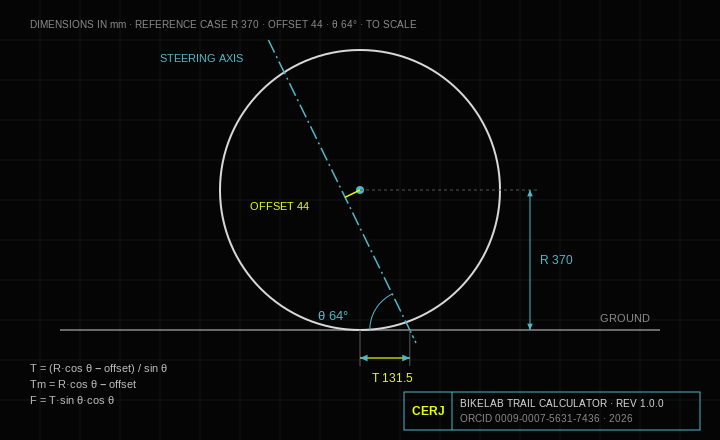

| Computes | Ground and mechanical trail, wheel flop, sensitivity of trail to head angle, offset and wheel size, and the change of trail under fork compression and balanced sag. |
|---|---|
| Model | T = (R·cos θ − offset) / sin θTm = R·cos θ − offset · F = T·sin θ·cos θΔθ = arctan(travel·sag·sin θ / wheelbase) |
| Verification | Engine copied byte for byte from the live calculator. Independent Python verifier written from the published equations: 20/20 checks (golden vectors, the article's reference case, analytic vs finite-difference derivatives, dynamic scenarios, sign guard). Node.js check of the real engine: 6/6, including a 4,464-input grid with maximum difference 0 against the closed form. |
| Known limits | The original 2026 oracle script was not preserved; the verifier was rebuilt on 2026-11-23 and is declared as such. The dynamic term is linearised (arctan ≈ x), exact to about 3° of change. |
| Errata | 2026-11-23: the method article said “+10 mm of wheel diameter → +4.9 mm of trail”; the correct value is +2.4 mm (4.9 is 10 mm of radius). Found by the new verifier; the calculator always showed 2.4; corrected in ES, EN and PT. |
| License | CC BY 4.0 (engine, vectors, verifiers) |
| Archive | DOI 10.5281/zenodo.24477625 (all versions) · v1.0.0: 10.5281/zenodo.24477626 |
| Software Heritage | swh:1:rev:109d2c84229e3f9afcf18d6aca8eedfe1a76aacb · permanent archive of the v1.0.0 code |
| Code & CI | github.com/carlosravello-png/bikelab-trail-calculator  |
| Use | live demo · full calculator (BikeLab Studio) |
| Cite | Ravello Joo, C. E. (2026). BikeLab Trail Calculator (Version 1.0.0) [Software]. Zenodo. https://doi.org/10.5281/zenodo.24477626 |
BikeLab PSI Calculator
Bicycle tire pressure: road/gravel constant-deflection model and MTB model.
| Computes | Front and rear pressure from system weight, tire width, rim, mounting and surface, with a 90 % uncertainty band (road/gravel); front and rear pressure for MTB by wheel, casing, rim, discipline and inserts. |
|---|---|
| Model | P = 600·L / W² + 0.75·W − 25W = nominal + δ + 0.4·(rim − 18) · Pfront = 0.93·PrearRoad/gravel model documented in 10.5281/zenodo.20671797. |
| Verification | Both engines copied byte for byte from the live calculator. Independent Python verifier written from the white paper reproduces its six published cross-validation cases (12 front/rear values): 10/10 checks. Node.js check of both real engines: 16/16, including 6,480 inputs against the white paper's closed form (maximum difference 0.002 PSI, from a constant the paper prints rounded) and the 8 MTB golden vectors with sign guard. MTB compared live against the SRAM AXS guide on 2026-11-23: 3 of 4 cases match to SRAM's two decimals. |
| Known limits | The MTB model is a fit to the public SRAM/Zipp guide (30 runs captured on 2026-07-02; fit r.m.s. 0.004 bar as recorded in the engine source), not an independent physical model; it matches SRAM with a 14 kg bike. On a 26-inch wheel with a 25 mm rim it is 4 % below SRAM's current guide. XC, enduro, DH and insert cases were not compared. The road/gravel band is an unseeded Monte Carlo; the central value is deterministic. The original oracle scripts were not preserved. |
| License | CC BY 4.0 (engines, vectors, verifiers; versions 1.0–2.0 keep their original license) |
| Archive | DOI 10.5281/zenodo.24479992 (from 3.0.0) · v3.0.0: 10.5281/zenodo.24479993 · versions 1.0–2.0: 10.5281/zenodo.20673124 |
| Software Heritage | swh:1:rev:d76a0fa901142aa7a22e3a2a99c15b0ab210965a · permanent archive of the v3.0.0 code |
| Code & CI | github.com/carlosravello-png/bikelab-psi-calculator  |
| Use | full calculator (BikeLab Studio) |
| Cite | Ravello Joo, C. E. (2026). BikeLab PSI Calculator (Version 3.0.0) [Software]. Zenodo. https://doi.org/10.5281/zenodo.24479993 |
BikeLab SAG Calculator
MTB air-spring pressure for forks and rear shocks at a target sag.
| Computes | Air pressure at the target sag for 132 suspensions (102 forks, 30 shocks) from 16 brands, the band shown to the rider, the suggested number of volume tokens and starting rebound/compression clicks. |
|---|---|
| Model | F(x) = P·A·(V0 / (V0 − A·x))1.30 − FfW = m·g·β / LR(sag) · β = 0.40 fork, 0.60 shockP solved by bisection (20–500 psi) so that F(sag) = W. Leverage from 26 catalogued frames, 6 generic linkage curves or a default by discipline. |
| Verification | Engine copied byte for byte from the live calculator (internal watermark SAG_MODEL_v5.0, 2026-02-26). Independent Python verifier written from the model: 55/55 checks (target sag, leverage, pressure and band for 13 golden vectors, plus sign guards). Node.js check of the real engine: 15/15, including 5,304 inputs (102 forks × 4 disciplines × 13 rider masses) with maximum difference 0.053 psi, inside the engine's 0.1 psi rounding. |
| Known limits | Single polytropic exponent (1.30) for every model; the negative chamber is not modelled separately (constant force term per model). The band is a fixed ±15/10/7/5 % by segment, not a measured confidence. For shocks without a catalogued frame, the wheel-sag percentage shown is computed against shock stroke and reads too high; pressure is not affected. White paper v3.0 describes per-model γ, an independent negative chamber and a 72–89 % confidence that are not part of the engine (listed in the README). The model was validated during development with 10,000 Monte Carlo iterations per model in Python; that script was not preserved and will be rebuilt and published. |
| License | CC BY 4.0 (engine, vectors, verifiers) |
| Archive | DOI 10.5281/zenodo.24484750 (all versions) · v1.0.0: 10.5281/zenodo.24484751 · June 2026 record: 10.5281/zenodo.20672790 |
| Software Heritage | swh:1:rev:6a590fe9132a25a709670a9fc74c4a4f802684b7 · permanent archive of the v1.0.0 code |
| Code & CI | github.com/carlosravello-png/bikelab-sag-calculator  |
| Use | live demo with force curve · full calculator (BikeLab Studio) |
| Cite | Ravello Joo, C. E. (2026). BikeLab SAG Calculator (Version 1.0.0) [Software]. Zenodo. https://doi.org/10.5281/zenodo.24484751 |
BikeLab FIT Analyzer
Cycling .fit activity files: a validated FIT reader, NP/VI and stability metrics with Monte Carlo bands.
| Computes | Reads a .fit file in the browser (the file never leaves the device) and reports cadence stability (CV_c), speed/cadence stability (CV_R), climbing stability (IES), Variability Index and power:heart-rate decoupling, each with a 500-iteration Monte Carlo band (median and 5th–95th percentile). |
|---|---|
| Model | NP = ( meant [ P̄30 s(t) ]4 )1/4 · VI = NP / APOn the 1 s series, zeros included; seconds without a sample take the last recorded value; pauses come from the FIT timer events. VI thresholds from the TrainingPeaks reference table (Help Center, article 204071734). |
| Verification | Engine copied byte for byte from the live pages (SHA-256 per function). FIT reader compared field by field (timestamp, altitude, heart rate, cadence, distance, speed, power) and on timer events against Garmin's decoder (@garmin/fitsdk 21.222.0): 47 public and 4 synthetic files, 218,537 records, 0 differences. Against fitdecode on the 5 files the Garmin JavaScript SDK cannot read: 9,627 records, 0 differences. Compressed speed/distance against python-fitparse's expected CSV: 754 rows, 0 differences. NP/VI against a textbook computation to 10⁻⁹. |
| Known limits | CV_c, CV_R, IES and Pw:HR thresholds are BikeLab heuristics not validated against measured data. Gravel uses the road VI thresholds (gravel is not in the reference table). Not tested on Polar, Bryton or Hammerhead files. CV_c, CV_R and IES count samples, not seconds. The 1.0.0 white paper describes gap interpolation, segmentation and Normal power noise that the engine does not implement. Minimal maintenance. |
| Errata | 2026-11-23: version 1.0.0 returned zero records for Garmin files (its reader stopped at the first data message of local type 0) and altered results outside bikelabstudio.com. Both were removed in 2.0.0; results from 1.0.0 are not comparable. |
| License | PolyForm Noncommercial 1.0.0 (engine and tests; noncommercial use is free, commercial use needs written permission) |
| Archive | DOI 10.5281/zenodo.24485833 (all versions) · v2.0.0: 10.5281/zenodo.24485834 · version 1.0.0: 10.5281/zenodo.20673166 |
| Software Heritage | swh:1:rev:f0cf8f435ea3030afdef07709e3199f0198001df · permanent archive of the v2.0.0 code |
| Code & CI | github.com/carlosravello-png/bikelab-fit-analyzer  |
| Use | the analyzer (BikeLab Studio) |
| Cite | Ravello Joo, C. E. (2026). BikeLab FIT Analyzer (Version 2.0.0) [Software]. Zenodo. https://doi.org/10.5281/zenodo.24485834 |
BikeLab Di2/AXS Diagnostic
Fault tree for Shimano Di2 and SRAM eTap AXS electronic shifting; every diagnosis cites the manufacturer document it comes from.
| Computes | Takes the rider through 7 questions (30 possible answers) to one of 22 results: 18 with a procedure the rider can do and 4 that send to a workshop or to the manual. Covers Shimano Di2 12-speed road (RD-R9250, RD-R8150, RD-R7150), Shimano Di2 11-speed with junction A, and SRAM eTap AXS road and XPLR. Runs in the browser, in English, Spanish and Portuguese. |
|---|---|
| Model | Not a numeric model: a decision tree stored as data (src/tree.json) and drawn by src/app.js. The script served on bikelabstudio.com is the one built from the repository (dist/di2_tool.js). |
| Verification | Every procedure checked on 2026-11-23/24 against Shimano's dealer and user manuals (DM-RARD010-08, DM-R8050-07, UM-71J0B; SHA-256 of each PDF and printed page numbers recorded) and against SRAM's Road AXS and XPLR AXS user manual and support pages. The claim-by-claim table is in docs/verification.md. The build fails if a diagnosis has no source; public CI rebuilds the page script and checks that it matches the archived one. |
| Known limits | Not covered: Shimano MTB Di2 12-speed (XTR M9200, XT M8200, Deore M6200), GRX Di2 12-speed, SRAM Eagle AXS and Transmission; those riders are sent to their manuals. There is no numeric check here: the checks are structural (tree integrity, a source on every diagnosis) and against the documents. The steps follow the documents as read on 2026-11-23/24; later manufacturer changes are not tracked automatically. |
| Errata | 2026-11-24: version 3.0.0 corrects the version served before, among other things the 12-speed adjustment (5 steps; the 4 steps it gave are the 11-speed value), the 12-speed wired-pairing time, how the shift mode is changed, and the AXS micro-adjust, which is done from the shifter. Claims without a manufacturer source were removed. Full list in docs/verification.md. |
| License | CC BY-NC 4.0 (diagnostic tree and code) |
| Archive | DOI 10.5281/zenodo.24488780 (all versions) · v3.0.0: 10.5281/zenodo.24488781 · June 2026 versions (CC BY-NC-ND 4.0): 10.5281/zenodo.20673193 |
| Software Heritage | swh:1:rev:a03d26a135f44207eef042a6d89de44ca1e01fb8 · permanent archive of the v3.0.0 code |
| Code & CI | github.com/carlosravello-png/bikelab-di2-axs-diagnostic  |
| Use | live demo · full tool (BikeLab Studio) |
| Cite | Ravello Joo, C. E. (2026). BikeLab Di2/AXS Diagnostic (Version 3.0.0) [Software]. Zenodo. https://doi.org/10.5281/zenodo.24488781 |
Feanor
Spanish documents to Markdown: scanned or photographed books, thesis PDFs, Word and PowerPoint, with a record of where each page's text comes from.
| Computes | Classifies each PDF page as digital, earlier OCR, uncertain, scanned or empty, and gives each one its route: text the PDF already has is copied as is; photographed pages that curve towards the spine are flattened before OCR. Also converts Word and PowerPoint, locates the references section and processes whole folders of theses with one result per file. Every run leaves a .json with the SHA-256 of the source, the tool versions and the git commit. |
|---|---|
| Model | Not a numeric model: a pipeline. Flattening with page-dewarp (MIT; Matt Zucker's method), used as a dependency; OCR with Tesseract (Apache-2.0) through OCRmyPDF (MPL-2.0), in Spanish (-l spa); PDF reading with PyMuPDF. Feanor adds the flow, the automatic crop, the page-type classification, the review flags and the run record. |
| Verification | 45 automated tests, run in public CI on every change (Ubuntu 24.04, Python 3.10 and 3.13, with Tesseract, OCRmyPDF and Ghostscript installed); with 0.6.0 they also passed on Windows, on the author's PC. Every claim in the README is mapped to its test or measurement in docs/VALIDATION.md. Measured with real material: in a phone-photographed book (14 pages), six of the seven pages curving towards the spine came out legible once flattened, and about 97 % of the words were correct on the page checked by hand; on 80 calibration theses, the references rule of 0.5.5 changed the cut in 16, all of them corrections. |
| Known limits | It does not produce verified text: figures, doses, quotations and names are checked against the original. There is no general error rate: the measurements describe their samples (14 pages of one book, 25 spreads, 80 theses), and the thresholds were tuned on the same sample they were evaluated on. On difficult pages, flattening gave different results on two machines with the same versions. Measured only in Spanish; macOS not tested. It locates the references section but does not split or check the references one by one. The books and theses behind the measurements are not in the repository (copyright). |
| License | MIT (code and tests; page-dewarp, OCRmyPDF, Tesseract and PyMuPDF keep their own licenses) |
| Archive | DOI 10.5281/zenodo.24522078 (all versions) · v0.6.3: 10.5281/zenodo.24535094 |
| Software Heritage | swh:1:rev:8f4e0a5570c21cf7c514a50d24e80f25bbb29532 · permanent archive of the v0.6.3 code |
| Code & CI | github.com/carlosravello-png/feanor  |
| Use | python -m pip install feanor-el-aplasta-libros · PyPI · feanor "libro.pdf" · full documentation |
| Cite | Ravello Joo, C. E. (2026). Feanor (Version 0.6.3) [Computer software]. Zenodo. https://doi.org/10.5281/zenodo.24535094 |
Model verification and audits of calculation tools for product and engineering teams. [email protected] · WhatsApp +51 977 647 243